The Cost of Winning: 5 of Swords, The Empress Disrobed and The Star’s Naked Truth
There are victories that feel like ash.
You get the last word. You keep your ground. You walk away with the swords in your hands. And yet something in the air is thinner than it was before. The room has lost warmth. Trust has bruised. The soil has been disturbed.
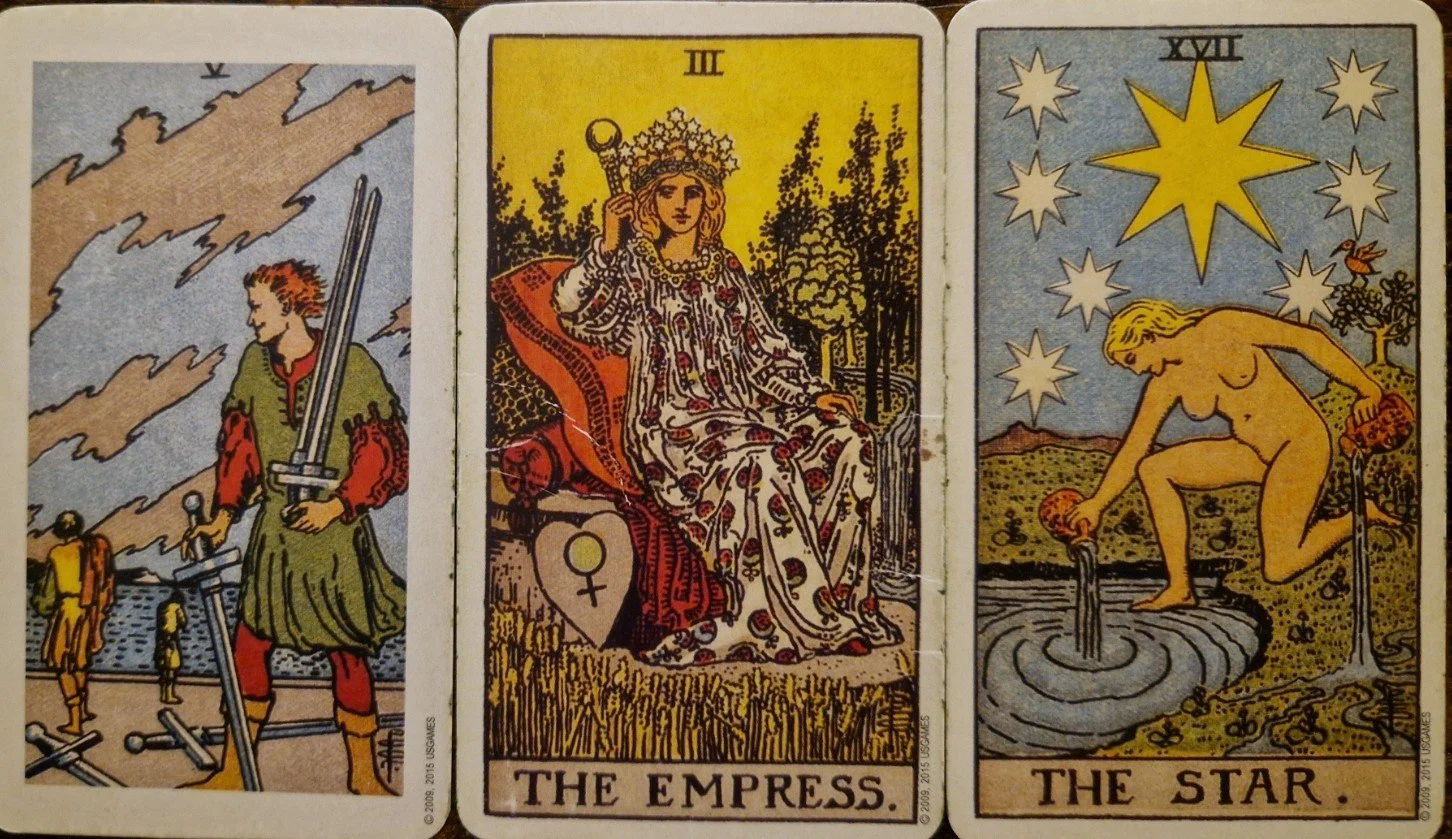
That’s the 5 of Swords. Not conflict itself, but conflict that takes dignity as payment.
This is a piece about that kind of moment. About what happens when “winning” becomes a power ritual. About Venus as the Empress stepping into a terrain where charm doesn’t protect her. About being disrobed of the tactics we rely on. About Aquarius, The Star, and the strange strength of standing naked in truth.
Because The Star doesn’t win the war. She restores fertility.
The 5 of Swords: the sharp edge of power
The 5 of Swords has a particular sound. It’s the snap of a sentence designed to cut. It’s the quiet pleasure of superiority. It’s the debate that turns into a dominance display. It’s the way a group goes silent after someone “wins.”
This card can show up as obvious argument. It can also show up as the subtle wars: passive aggression, correction-as-humiliation, sarcasm, the little twist of the knife that proves who’s smarter, who’s stronger, who gets to define reality.
The cost isn’t always immediate. Sometimes the cost is delayed. The cost is the friend who stops confiding in you. The cost is the team that stops offering ideas. The cost is the relationship that becomes cautious. The cost is the community that fractures into factions because the atmosphere no longer feels safe.
The 5 of Swords doesn’t only point to an “enemy.” It points to the part of us that reaches for control when we feel exposed. It’s the nervous system trying to secure safety by taking the high ground.
It’s also a spell: if I win, I won’t be hurt.
Venus as The Empress: the power that grows life
Venus as the Empress doesn’t conquer. She cultivates.
Her power is fertile. Relational. Earthy. She grows what she touches. She is the orchard, the field, the warm bread, the soft animal body, the perfume of blossoms on the wind. She knows how to feed. She knows how to tend. She knows that life expands through care and consistency, not through dominance.
In personal terms, Empress/Venus is value that doesn’t need to prove itself. It’s self-worth that isn’t bargaining. It’s creativity that comes from the root, not from the need to be seen as special.
In community terms, Venus is cohesion. The social glue. The agreements that make belonging possible. The tenderness that keeps people human with each other. The quiet rituals of repair.
So when the 5 of Swords is active, Venus often finds herself in a difficult landscape: a landscape where her gifts are treated like weakness, where care is exploited, where harmony is used as a leash, where “being nice” becomes a survival strategy.
And this is where the underworld motif begins.
The disrobing: when Venus loses her armour
There are moments when the Empress cannot keep her crown on.
Not because she isn’t powerful, but because the room is playing a different game. Some spaces are not moved by beauty. Some people are not moved by grace. Some dynamics are not softened by sweetness. The 5 of Swords doesn’t respond to charm. It responds to leverage.
So Venus is disrobed.
This isn’t a moral lesson. It’s initiation language.
The “garments” Venus wears are often invisible: the need to be liked, the habit of smoothing things over, the ability to make everyone comfortable, the instinct to keep the peace, the performance of being “fine.” These can be true gifts. They can also become armour. A way to manage other people’s reactions so we don’t have to risk rejection, conflict, or loss.
Disrobing is the moment those garments stop working.
You try to explain yourself and it changes nothing. You try to keep things sweet and the sweetness is used against you. You try to remain agreeable and you realise you’re shrinking. You keep offering harmony and you begin to feel that harmony has become a currency you pay to stay safe.
This is the moment Venus learns a different kind of power: the power of truth without performance.
It’s very Inanna-coded. In the old descent myth, the goddess goes down and is stripped at each gate until nothing remains but essence. The point isn’t humiliation. The point is balance. Renewal comes through exchange. The underworld takes what cannot travel into the deep. Only the essential returns.
On an inner level, the question becomes simple and uncomfortable: what am I using to control this situation?
Sometimes the answer is obvious. Sometimes it’s “niceness.” Sometimes it’s beauty. Sometimes it’s sexuality. Sometimes it’s helpfulness. Sometimes it’s spiritual language. Sometimes it’s being the one who never needs anything.
When Venus is disrobed, she stops trying to win the game. She sees the game.
Aquarius and The Star: the medicine of naked truth
Aquarius is often linked with The Star in Tarot tradition. The Star is naked and unashamed. She pours water back into the earth. She pours water into the pool. She restores what has been scorched.
This is not naïve sweetness. It’s a deep, quiet medicine.
The nakedness matters. It’s the opposite of the 5 of Swords posture.
The 5 of Swords wears armour made of cleverness, strategy, superiority, protection-through-domination.
The Star takes the armour off.
Not to be harmed, but to be honest. Not to surrender dignity, but to reclaim it. Nakedness here is transparency. It’s spiritual cleanliness. It’s the refusal to manipulate. It’s the refusal to perform goodness as a way to control the room.
And then there is the pouring.
The Star doesn’t take the swords. She returns water to the soil.
This is the moment the story turns from win/lose to repair/renew.
From a mystical angle, The Star is a purifier. She pulls the poison out of the ground. She rinses the roots. She brings fertility back through gentle persistence rather than force.
From an earthy angle, she is what you do after the fire: you water the land. You re-seed. You rebuild the ecosystem.
She doesn’t deny what happened. She doesn’t pretend the conflict was “for the best.” She chooses what grows next.
The shift: a different definition of victory
If you’ve ever been trapped in a 5 of Swords dynamic, you know how seductive it can be. There’s a rush to it. A tight bright satisfaction. A feeling of control.
It’s also exhausting.
The Empress disrobed is the moment you realise: I can’t buy safety with performance anymore.
The Star is the moment you realise: I don’t want that kind of safety.
A Star-level victory doesn’t look like domination. It looks like restoration.
It looks like telling the truth once, cleanly, and letting it stand. It looks like choosing boundaries over battles. It looks like refusing to humiliate even when you’re angry. It looks like not recruiting allies to make someone a villain. It looks like stepping out of the power game and tending to what matters.
And on a larger scale, this is leadership medicine too.
There’s leadership that wins by fear, by spectacle, by scapegoating, by control.
There’s leadership that restores fertility: transparency, accountability, proportional response, the willingness to lose status in order to repair trust.
The Star asks: what kind of power makes life possible here?
A small ritual for this week
If you want to work with this theme in a grounded way, try this as a simple ritual. Nothing fancy. Just honest.
First, name the 5 of Swords impulse without judging it.
“Where do I want to win because I feel unsafe?”
Then name the Venus garment you’re ready to remove.
“What am I using as armour? Niceness? Charm? Being indispensable? Being above it? Being unbothered?”
Then speak one Star sentence.
Not a speech. A sentence.
The truest, simplest version of what you need or what you see.
Finally, choose one act of restoration.
Something small and real: a boundary, a repair attempt, a withdrawal of energy from a toxic loop, a return of attention to what nourishes you.
If you want a question to carry with you, make it this:
“What restores fertility here?”
Because the deepest magic isn’t winning. It’s composting what’s dead, returning water to the ground, and letting something true grow.